RajajiC. Rajagopalachari
Chapter 03 — Freedom movement

From law to nationalism

Not a timeline — a sequence of causes and consequences. Each decision below was taken for stated reasons, and each produced results its author did not entirely control.

Cause — 1919

The Rowlatt Act

Wartime emergency powers of detention without trial were extended into peacetime. Across India, and especially among lawyers, the Act was read as proof that constitutional reform would not be allowed to limit executive power.

Consequence

Rajagopalachari, then a successful advocate at Salem, joined the protest and met Gandhi, who stayed at his home in Madras during the agitation. Within a short period he wound up his legal practice. The professional life he had built over twenty years ended; the political life that would last another fifty began.
Cause — 1920–22

Non-Cooperation

Gandhi’s first mass campaign asked Indians to withdraw from British courts, schools, titles and legislatures. It demanded organisation as much as sacrifice: someone had to run the provincial committees, collect the funds and keep the records.

Consequence

Rajaji became one of the Congress’s working organisers in the south and served as a general secretary of the party in the early 1920s. He was imprisoned for the first time in this period. When the movement split over whether to enter the legislatures, he stood with Gandhi’s “no-changers” against C. R. Das and Motilal Nehru’s Swarajists — his first significant quarrel with a Congress majority.

Cause — 1925

The Tiruchengode ashram

Between campaigns, Gandhian politics meant constructive work: spinning, village industry, temperance, and the removal of untouchability.

Consequence

Rajaji founded an ashram at Tiruchengode in Salem district and made it a base for khadi production, prohibition campaigning and anti-untouchability work. The ashram trained the volunteers who would later walk with him to Vedaranyam, and it gave his later prohibition policy a personal history that his critics could not dismiss as opportunism.

Cause — 1930

The salt laws

The colonial state held a monopoly on salt and taxed it — a levy that fell on every household in India. Gandhi chose it as the point at which an entire population could break the law at once.

Consequence

The Vedaranyam march, described in full below. Rajaji was arrested and imprisoned; the Tamil districts acquired their own mass campaign, and Rajaji acquired the standing in Madras politics that he held for the rest of his life.

Cause — 1942

Quit India

With Japanese forces advancing through Burma, the Congress moved towards a demand for immediate British withdrawal. Rajaji argued that a mass agitation during an invasion risked chaos, and that the Congress should instead settle with the Muslim League and share responsibility for government.

Consequence

He was defeated in the Congress Working Committee, resigned his membership and his seat, and spent the next two years outside the party arguing his case in public — while the leaders who had voted against him spent it in prison. It is the sharpest single break of his career, and historians still divide over whether it was foresight or misjudgement.

A political friendship

Gandhi

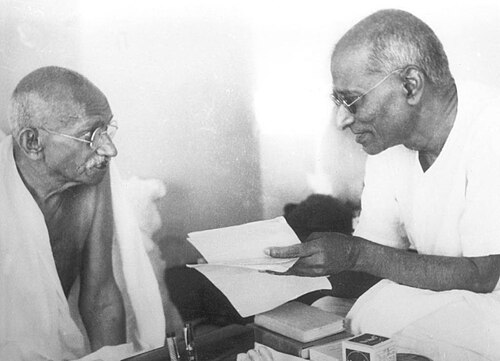
Gandhi relied on Rajaji’s judgement more than on almost anyone’s outside his immediate circle, and he is widely reported to have called him “the keeper of my conscience”. He stayed in Rajaji’s house, argued with him in writing for decades, and sent him to do work — in Bengal, in the Tamil districts, with the League — that he trusted few others to do.

Ideas

Rajaji

Rajaji accepted Gandhi’s methods but not his economics, and said so. He doubted the practicality of village self-sufficiency as a national programme, thought industrial production necessary, and was more comfortable than Gandhi with the machinery of the modern state — while insisting that machinery be kept small.

They were not interchangeable. The two men disagreed about the 1922 withdrawal, about entering the legislatures, about the war, and finally about Quit India, which Gandhi carried and Rajaji opposed. Their families were joined in 1933 when Rajaji’s daughter married Gandhi’s son, a marriage across caste lines that both fathers initially discouraged and eventually blessed.

What held the relationship together was a shared method: put the disagreement in writing, keep it public, and do not let it become personal. Rajaji left the Congress in 1942 without leaving Gandhi.

On quotationsThe phrase “keeper of my conscience” is very widely reported in biographies and journalism of the period and after. Like many remarks of Gandhi’s, it survives in report rather than in a single verified manuscript, and it is given here as a reported description, not as a documented quotation.

Mahatma Gandhi seated at left and C. Rajagopalachari at right, working together over papers at a low desk.
Gandhi and RajajiThe two men at work over papers. Undated photograph.
The feature

The Vedaranyam salt march

Gandhi’s march to Dandi in March 1930 is the image that survives. It was not the only one. The Congress planned parallel breaches of the salt law across India, and in the Tamil country the campaign was given to Rajagopalachari.

He set out from Tiruchirappalli on 13 April 1930 with a small band of volunteers, walking roughly a hundred and fifty miles east through the delta districts to the coastal village of Vedaranyam. The march was deliberately slow. At every village the volunteers spoke, sang, enrolled recruits and left behind local committees; the walking was the argument.

At Vedaranyam at the end of April the volunteers gathered salt from the shore in open breach of the law. Police broke up the gathering and made arrests, Rajaji among them. He was imprisoned; the campaign continued in the districts he had walked through.

It is worth being exact about what this was. No one was armed and no one fought. The march was a piece of political theatre with legal consequences attached — designed so that an ordinary act, picking up salt, would force the state either to tolerate open defiance or to arrest unresisting people in public. Both outcomes served the campaign.

Set out

13 April 1930, from Tiruchirappalli

Distance

Roughly 150 miles on foot, through the delta districts

Destination

Vedaranyam, on the Coromandel coast

Act

Salt gathered from the shore in breach of the salt laws

Outcome

Arrests, including Rajaji’s; imprisonment; the campaign spreads in the Tamil districts

Where accounts differSources vary on the exact number of volunteers who began the march and on the precise date of the salt-making at Vedaranyam. The route, the month and the arrests are well attested; the fine detail is not, and is not asserted here.

Organisation and prison

The unromantic half of the movement

Between the campaigns lay the ordinary work of a political party: committees, subscriptions, newspapers, candidate selection, quarrels over funds. Rajaji was good at it, and much of his authority in the Congress came from that rather than from oratory, which was never his strength.

He was imprisoned on several occasions across two decades of civil disobedience. Prison, for the Congress leadership of his generation, was also a reading room: Rajaji used the terms to write, and some of his best-known literary work grew out of enforced idleness.

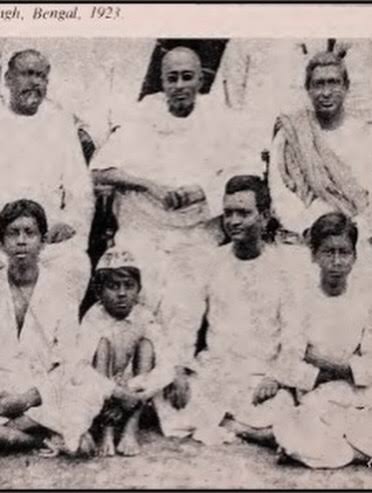
A group of men in white khadi photographed together, from a printed source captioned Bengal, 1923.
Bengal, 1923Reproduced from a printed source whose caption survives only in part. The individuals other than Rajaji are not identified here, because the printed caption is incomplete.
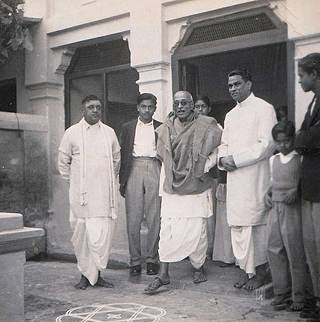
C. Rajagopalachari standing in the centre of a small group of colleagues outside a house, with a kolam drawn on the ground.
Political workersRajaji with colleagues outside a house in the Madras Presidency. Undated.
1942–1947

Outside the party, inside the argument

The years after his resignation were the loneliest of his career. He argued in public that the constitutional deadlock could only be broken by conceding the principle of self-determination to Muslim-majority areas, and in 1944 published the proposal that became known as the C. R. Formula. Jinnah rejected it as insufficient; the Congress rank and file treated it as a betrayal; the Hindu Mahasabha attacked it outright.

He returned to the Congress fold before independence and took office in the interim government of 1946–47, holding the portfolios of industries and supplies and later education and finance during a period of acute shortage.

Whether the formula was a road not taken or a proposal that was never going to be accepted is examined in The Arguments, with the case against it stated as strongly as the case for.