What remains?
He died on 25 December 1972, aged ninety-four. What survived him was not a party and not a school of followers, but a set of arguments, a shelf of books, and a reputation that historians are still adjusting.
A public life commemorated
In 1954 he was among the first three people to receive the Bharat Ratna, India’s highest civilian honour, alongside C. V. Raman and S. Radhakrishnan. In 1958 the Sahitya Akademi recognised him as an author in his own language.
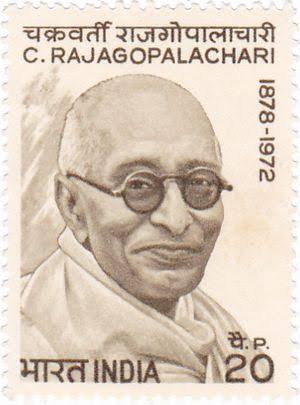
Places carry his name across India: Rajaji National Park in Uttarakhand; Rajaji Marg in New Delhi; Rajaji Hall and Rajaji Salai in Chennai. India Post has issued commemorative stamps in his memory.
Public memory in Tamil Nadu is more complicated than a list of honours suggests. He is read as an author and respected as a statesman, while the education scheme of 1953 and the Hindi order of 1938 are remembered in Dravidian political argument to this day. Both memories are accurate.
Constitutional
He is the only Indian to have held the office of Governor-General and the last person to hold it at all. The twenty months he spent keeping a ceremonial office strictly ceremonial helped establish, in the republic’s first years, that the head of state acts on the advice of ministers.
Economic
The case against industrial licensing that he made from 1959 was made again, by governments rather than by oppositions, after 1991. His admirers read the reforms as vindication; other historians reply that the early public investment he opposed built the industrial base those reforms then liberalised.
Literary
The Ramayana and Mahabharata retellings have been in print for more than half a century and are still, for many readers in India and abroad, the first complete encounter with either epic. His Tamil work won the Sahitya Akademi Award in 1958.
Democratic
Founding an opposition party at eighty, against a governing party he had helped build, is an unusual act in any democracy. The argument he made for it — that a system without a credible alternative government decays — is now conventional in Indian political writing.
Contested
The 1938 Hindi order and the 1953 education scheme are part of his record too, and both are actively remembered in Tamil Nadu. A legacy is not only what a person would have chosen to be remembered for.
Rajaji was not easily categorised
These tensions are documented, not invented for effect. Each pair below describes two things that were true of him at once, or true of him at different times.
He gave up a legal career for the national movement and went to prison for it repeatedly — and then opposed his own party’s central decision in 1942, resigned, and argued against it in public while its leaders were in jail.
He was among Gandhi’s closest political colleagues and is widely reported to have been called the keeper of his conscience — while doubting the economics of village self-sufficiency, accepting the need for industry, and disagreeing with Gandhi on the war, on the legislatures and on Quit India.
General secretary of the Congress in the 1920s, Premier, Governor-General, Home Minister, Chief Minister — and then, from 1959, the founder of the party that fought the Congress from the right of its economic policy.
A practising, orthodox Hindu who read and retold the epics all his life, and the Premier who legislated to open temples to Dalits over the objections of orthodox authority.
He held some of the highest offices in India, and spent far more of his life writing than governing. The books have outlasted every ministry he led.
The Premier who made Hindi compulsory in Madras schools was the same man who, twenty-seven years later, supported the Tamil case against imposing Hindi nationally. He reversed himself in public and did not pretend otherwise.
Where historians still disagree
On 1942. Was his opposition to Quit India a failure of nerve at the decisive moment, or an accurate reading of the risks of mass agitation during an invasion? Both cases are argued in the literature.
On 1944. Was the C. R. Formula a serious attempt to limit the damage of partition, or a concession that weakened the Congress position without gaining anything? Jinnah’s rejection is a fact; what it proves is disputed.
On economics. Was he twenty years ahead of Indian economic policy, or arguing against the state investment that made later growth possible? The 1991 reforms are read as evidence by both sides.
On Madras. Was the 1953 education scheme a misunderstood fiscal measure or a policy whose caste consequences were foreseeable? His defenders and his critics have not converged.
Where scholarship divides like this, this website reports the division rather than choosing for the reader.
The last of the founding generation to keep arguing
He outlived Gandhi by twenty-four years, Patel by twenty-two and Nehru by eight, and he was still writing weekly at the end. He died in Madras at the age of ninety-four, in the year that his party’s last effective phase ended.
What he left is unusually legible for an Indian politician of his era: the offices are in the record, the arguments are in print, and the objections to them were published at the time by people who thought he was wrong. There is no need to guess at what he believed.