RajajiC. Rajagopalachari
Chapter 06 — Ideas and debates

The
arguments

Ten questions Rajaji spent his life answering in public. His position is given first, then the strongest case against it, then what the argument turned out to mean. The opposing views are stated as their holders would have stated them.

Signature interaction — the debate slider

How much should the state decide?

Drag the handle to move across the range of positions actually argued in India between roughly 1950 and 1970. Rajaji stood towards one end of it. Almost nobody stood at either extreme.

More state control More individual liberty
A mixed economy with limited controls

The middle ground held by many Congress economists and by business federations: public investment in infrastructure and heavy industry, private enterprise elsewhere, with controls used sparingly and temporarily. Much of the argument in India between 1955 and 1975 was about where inside this band the line should fall.

A conceptual deviceReal political positions are not points on a line. This slider is a teaching device that arranges five recognisable positions from the period in order of how much they asked government to decide. People moved along it, held different positions in different decades, and combined views that this simplification cannot show.

Ten arguments
01

Should development be planned from the centre?

Context: the Congress adopted a socialistic pattern of society in 1955, and the Second Five-Year Plan of 1956 committed India to state-led heavy industry. In January 1959 the Nagpur session of the Congress resolved in favour of cooperative joint farming and state trading in foodgrains.

Rajaji’s position

Planning on this scale concentrates economic decisions in offices that cannot possibly hold enough information to make them well, and hands officials a power over private life that no democratic check can reach. The Nagpur resolution alarmed him most: state trading in food and joint cultivation, he argued, would put the peasant’s land and the family’s food supply at the discretion of the administration.

The case against him

India in 1956 had almost no domestic capital market, a tiny industrial base, and a population living close to subsistence. Left to private investment, steel, power, machine tools and fertiliser would not have been built at all, or would have been built by foreign capital on foreign terms. Planning was the only instrument available for turning a poor agrarian economy into an industrial one within a generation, and it did build a heavy-industrial base that later governments inherited.

AfterwardsJoint cooperative farming was never implemented on the scale Nagpur envisaged. Industrial licensing survived until the reforms of 1991, when much of it was dismantled — a reversal that made Rajaji’s critique look prophetic to his admirers, while historians of Indian development continue to argue that the early public investment was a precondition for what came after.
02

Who should be allowed to start a business?

Context: under the Industries (Development and Regulation) Act 1951 and the licensing system built on it, private firms needed government approval to establish capacity, expand it, change product lines or import equipment.

Rajaji’s position

The licensing system created a market in permissions rather than in goods. It rewarded whoever could work the offices in Delhi, penalised whoever could not, and made corruption structural rather than incidental. The phrase “permit-licence-quota raj” is widely attributed to him, and it is the argument of his later journalism in a single expression.

The case against him

Unregulated entry in a capital-scarce economy would have concentrated production in a handful of existing business houses and in the richest regions. Licensing was intended to spread industry across states, reserve sectors for small producers, and stop scarce foreign exchange being spent on luxuries. Critics of Rajaji argued that his “free enterprise” would in practice have meant freedom for the already large.

AfterwardsBoth charges have evidence behind them. The licence system did generate rent-seeking and did constrain output; concentration of Indian industry in a few large houses also grew during the licence period. The phrase Rajaji popularised entered the language and was quoted freely by the reformers of the 1990s.

03

What is individual liberty for?

Context: a founding argument of the Swatantra Party, and the theme of Rajaji’s weekly journalism from 1956 onwards.

Rajaji’s position

Political freedom without economic freedom is incomplete. A citizen who must obtain official permission to farm, trade or manufacture is dependent on the state in the part of life where he spends most of his hours. Liberty, on this view, is not a luxury that a poor country postpones until it is rich; it is the condition in which people improve their own circumstances.

The case against him

For a landless labourer, formal liberty without land, literacy or bargaining power is close to meaningless. The socialist reply was that real freedom requires redistribution first — land reform, public schooling, guaranteed employment — and that a doctrine of non-interference protects existing property relations, however those relations arose.

AfterwardsThis is the oldest argument in modern politics and it was not settled in India either. Both propositions survive in Indian public debate, frequently in the same speech.

04

How much power should the centre hold?

Context: the Indian Constitution created a strong union with wide legislative and emergency powers, an arrangement defended at the time by the need to hold a newly partitioned country together.

Rajaji’s position

He favoured genuine authority for the states and was consistently suspicious of centralisation, in economic administration as in constitutional design. A country of India’s size and variety, he argued, is better governed close to the ground, and a distant administration will misjudge local conditions with perfect confidence.

The case against him

India in 1950 had just absorbed several hundred princely states, was managing a refugee crisis and an armed dispute over Kashmir, and contained linguistic and communal fault lines that a weak centre might not have survived. The framers’ answer was that a strong union was the price of holding the federation together at all.

AfterwardsCentre–state relations remain among the most actively contested questions in Indian politics, from the use of Article 356 to the design of the Goods and Services Tax.

05

Could partition have been negotiated instead of suffered?

Context: in 1944, out of the Congress and with its leadership imprisoned, Rajaji published a proposal — the C. R. Formula — for breaking the deadlock between the Congress and the Muslim League.

Rajaji’s position

The League’s claim would not go away by being denied. He proposed that after the war a commission demarcate the contiguous Muslim-majority districts of the north-west and north-east, that a plebiscite of their adult population decide whether they separated, and that in return the League join an interim government at once, with agreements to follow on defence, communications and commerce. His argument was that a negotiated settlement, decided by vote and prepared in advance, would be less terrible than an unnegotiated one decided in a hurry.

The cases against him

Jinnah rejected the formula: he wanted whole provinces rather than demarcated districts, and held that only Muslims should vote in any plebiscite. Congress opinion held that Rajaji had conceded the principle of partition before any negotiation had begun, weakening the national position for nothing. The Hindu Mahasabha attacked it as a surrender of territory. A fourth criticism came later from historians: that no formula on paper could have restrained the communal violence of 1946–47.

AfterwardsPartition happened in 1947 on lines drawn in five weeks, with a death toll usually estimated in the hundreds of thousands and a displacement of some ten to fifteen million people. Whether an earlier negotiated settlement would have reduced that, or merely have brought it forward, is one of the genuinely unresolvable questions of modern Indian history. It is raised here because it was the most consequential argument Rajaji ever lost — not because this website can answer it.

06

Which language should the state require?

Context: his Madras government made Hindi compulsory in secondary schools in 1938; twenty-seven years later he opposed the same policy at national level.

Rajaji’s positions

In 1938: a common language would help bind a national movement and, in time, a national administration; Tamil children should not be excluded from either for want of Hindi. By 1965: compulsion in language is resented as a status claim by one region over another, English is a workable link language precisely because it belongs to no Indian region, and Tamil should not be displaced. He supported the Tamil case in the anti-Hindi agitation of 1965.

The case against each

Against 1938: the policy was imposed by a ministry with no mandate for it, on children in a state where the language was not spoken, and it fed a Dravidian movement that argued the Congress could not be trusted with Tamil interests. Against 1965: supporters of Hindi replied that retaining English privileged an English-educated elite and kept the language of the colonial administration at the centre of national life.

AfterwardsThe 1937–40 agitation is a founding episode of Dravidian politics; the 1965 agitation reshaped Tamil Nadu’s party system. India settled on a formula under which English continues alongside Hindi for official purposes. Rajaji changed his mind on this question in public, which is rarer in political life than being right the first time.

07

What should a poor state spend on schooling?

Context: the modified elementary education scheme introduced in Madras State in 1953, and withdrawn in 1954.

Rajaji’s position

Full-day schooling for every child was beyond the state’s means. A shift system would let the same buildings and teachers reach far more children, and the hours outside school could be spent learning practical work at home. His defence was arithmetic: reaching more children imperfectly was better than reaching fewer completely.

The case against him

In a society where occupation followed caste, a scheme in which children learned their family’s trade at home would reproduce caste occupations under state sanction, whatever its author intended. Opponents named it the caste-education scheme. Dravidian parties, Dalit organisations and members of his own party opposed it; the government fell and the scheme was withdrawn.

AfterwardsHis successor, K. Kamaraj, took the opposite route — expanding schooling and introducing the midday meal programme that Tamil Nadu became known for. On the historical record, the expansionary approach worked, and this remains the most damaging single episode of Rajaji’s career.

08

Should caste be reformed from inside or confronted from outside?

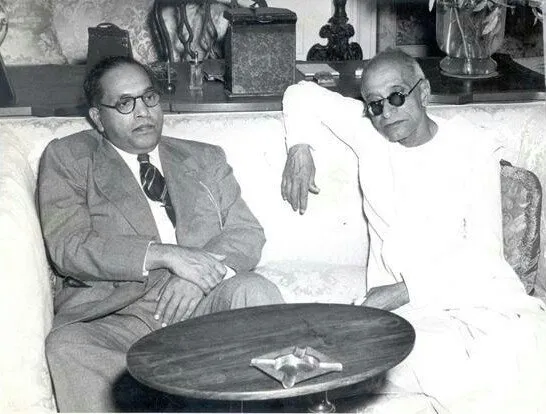
Context: Rajaji campaigned against untouchability from the 1920s and legislated for temple entry in 1939. B. R. Ambedkar, photographed with him below, argued a fundamentally different case.

Rajaji’s position

Untouchability was an accretion that the tradition itself did not require, and could be removed by reform from within — by opening temples, by shared work in the ashram, by law where custom resisted. He acted on this consistently and at political cost, well before it was expedient to do so.

The case against him

Ambedkar’s position was that the disability was not an accretion but a structure, that reform led by upper-caste reformers left the structure intact, and that what Dalits needed was political power, legal rights and representation rather than admission to temples. On this view Rajaji’s reforms were sincere and insufficient.

AfterwardsThe Constitution abolished untouchability in Article 17 and provided for reservation in legislatures, education and public employment — broadly the Ambedkarite route. Temple-entry laws remain in force. The underlying argument about whether hierarchy is reformed or dismantled is unresolved and continues in Indian politics today.

09

Does a democracy need an opposition it can lose to?

Context: the Congress won every general election from 1952 to 1967 with large majorities in a first-past-the-post system.

Rajaji’s position

A parliamentary system in which one party is never seriously threatened will decay, whatever the intentions of the people running it, because no government examines itself as carefully as an opposition examines it. He founded the Swatantra Party at eighty largely on this reasoning — not only to advance particular policies, but to create an alternative that could hold office.

The case against him

Congress dominance reflected genuine electoral support and the party’s standing from the freedom movement; it was not a manufactured monopoly. A more pointed criticism was that Swatantra’s support base — former princes, landowners and business — made it an unconvincing vehicle for democratic renewal, whatever its stated principles.

AfterwardsSwatantra became the largest opposition party in the Lok Sabha in 1967 and then declined, dissolving in 1974. The Congress system itself broke up over the following decade. The argument that competition disciplines government is now conventional wisdom in Indian political writing.

10

May a free state imprison without trial?

Context: independent India retained preventive detention. The Preventive Detention Act of 1950 was passed in the republic’s first weeks and renewed repeatedly thereafter.

Rajaji’s position

In his later journalism he became a severe critic of the state’s coercive powers and of the ease with which governments reach for them, arguing that a citizenry that had opposed the Rowlatt Act should not accept its equivalents from its own ministers.

The complication, and the case against

He was Union Home Minister in 1950–51, when those powers were on the statute book and in use, and he was in the cabinet during the first constitutional amendment of 1951, which narrowed the guarantee of free speech. Critics have reasonably asked why the objection arrived after the office did. The defence offered by his admirers is that the responsibilities of 1950 and the arguments of 1965 were about different governments in different circumstances — a defence that readers may or may not accept.

AfterwardsPreventive detention has remained part of Indian law throughout the republic’s history, and became the central civil-liberties question during the Emergency of 1975–77, three years after Rajaji’s death.

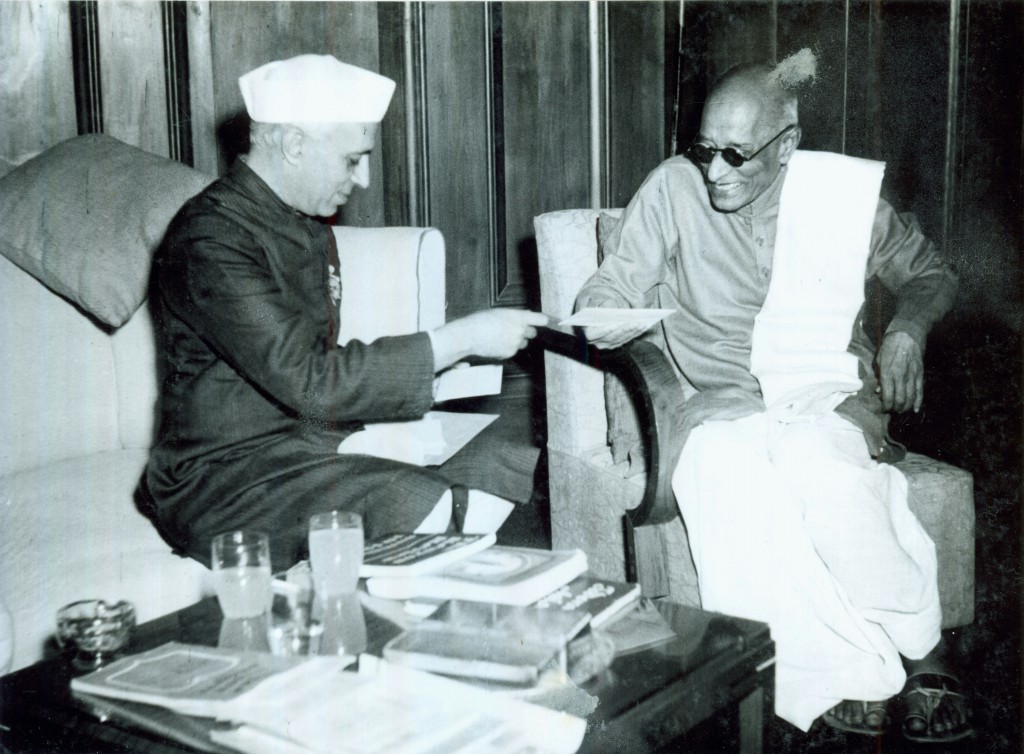
Jawaharlal Nehru seated at left passing a paper across to C. Rajagopalachari, who is seated at right in a shawl, with books on the low table between them.
Opponents, not enemiesNehru and Rajaji. They disagreed publicly and at length about planning, licensing and the size of the state, while remaining on terms that allowed the disagreement to be conducted in the open.
B. R. Ambedkar in a suit seated at left and C. Rajagopalachari in white khadi seated at right, on a sofa with a low table before them.
Two routes out of casteRajaji with B. R. Ambedkar. Their disagreement about how caste should be confronted is set out in argument 08 above.